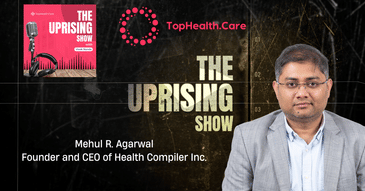
In this episode of The Uprising Show, Vivek sits down with Mehul R. Agarwal, Founder and CEO of Health Compiler Inc., to explore the complexities of healthcare data integration and the evolution of building tech-driven solutions for the industry. Mehul R. Agarwal shares his journey from founding a healthcare integration services company in 2019, through various pivots, to creating Health Compiler, a cutting-edge data platform focused on the self-funded and direct care healthcare models.
Together, they dive into the major disconnects healthcare organizations face, especially the challenges in bridging claims and clinical data, and the importance of making data truly actionable for providers, brokers, and employers. The conversation covers the art of pivoting in a startup, lessons learned from failed productization attempts, the necessity of deeply understanding customer needs, and the impact of artificial intelligence on the future of healthcare practices. Mehul R. Agarwal also offers valuable insights for clinicians looking to leverage data for better outcomes and efficiency, while discussing his vision for the company and the evolving landscape of data-driven healthcare.
Timestamps:
00:00 Pivoting from Health Platform
06:00 Healthcare data integration challenges
09:12 Balancing cost and quality in healthcare
11:15 AI reducing admin tasks in healthcare
13:38 Focusing on customer-driven growth
17:50 App improves lab test communication
19:51 Refreshing memory on info
Unlocking Healthcare Data: Insights from Mehul R. Agarwal, Founder of Health Compiler
Healthcare data is more abundant than ever, but making sense of that data is another story. In a recent podcast episode, Mehul Agarwal, founder and CEO of Health Compiler, shed light on the complexities of healthcare data integration, startup pivots, and the future of data-driven healthcare. Here are the top insights from the discussion.
The Big Disconnect: Claims and Clinical Data
Right at the start, Mehul Agarwal identified a critical issue facing healthcare organizations. While tools and technology are plentiful, there is a significant disconnect between clinicians and brokers. Clinicians rarely get access to claims data, whereas brokers and TPAs may have claims but don’t see the clinical side. Stitching together claims and clinical data tells the complete story and enables better decision-making at every level. According to Mehul Agarwal, successful solutions must merge multiple data sources to present actionable insights in a consumable way.
Health Compiler’s Evolution: From Services to Product, and Pivots in Between
In the journey of Health Compiler, pivoting wasn’t a one-time event but a process. Mehul Agarwal started in 2019 with a healthcare integration services company, moved to building a health integration platform called Compile, and ultimately launched Health Compiler as a comprehensive data platform. The reason for pivoting? Customer demand and shifting market realities. Mehul Agarwal noticed customers preferred having integrations built for them rather than paying ongoing API fees. This realization led to the hard decision to completely rebuild their technology from scratch, focusing on addressing direct pain points for self-funded and direct care healthcare models.
Building on EHR Integration Expertise
Integration with Electronic Health Records (EHR) is a major hurdle for many health tech startups. Thankfully, Mehul Agarwal and his team brought deep integration experience to the table, having worked with over 200 EHR systems. This background gave them a significant advantage, allowing Health Compiler to seamlessly connect with a myriad of healthcare data sources.
The Metrics That Matter for Physicians
For physicians, it’s easy to get lost in the sea of data. Mehul Agarwal shared that the most important metrics are those at the intersection of cost and care. Questions around quality of care, engagement rate, urgent care avoidance, and ER visit reduction deliver the most impactful insights. If providers can track avoided urgent care or ER visits, they’re looking at real financial savings and better patient outcomes.
The AI Revolution in Data-Driven Healthcare
The conversation turned toward the future, and Mehul Agarwal sees a major shift coming thanks to artificial intelligence. Administrative burden is a constant pain for clinicians. AI can handle many of those processes, freeing up providers to focus on patient care. More importantly, actionable, data-driven insights will empower stakeholders, clinicians, employers, brokers, and carriers alike. With triaging already benefiting from AI, the potential for smarter, more efficient healthcare is closer than ever.
Always Listen to Customer Feedback
Last but not least, Growth can bring about bias and lead companies to stop listening to users. Mehul Agarwal emphasized that maintaining a hands-on approach and continuously gathering, analyzing, and acting on customer feedback is key to sustainable growth and ongoing product relevance. As competition intensifies, staying close to real-world problems ensures that solutions stay effective and valuable.
Conclusion
The insights shared by Mehul Agarwal in the podcast episode outline a roadmap for health tech innovators and healthcare providers alike: bridge data silos, focus on impactful metrics, leverage integration experience, embrace AI, and never stop listening to your customers. Health Compiler’s journey demonstrates that the right blend of technology, attitude, and adaptability can reshape the healthcare landscape for the better.
If you want to improve healthcare outcomes and decision-making, follow the lessons from Health Compiler and keep your finger on the pulse of both your data and your customer needs.
The Uprising Show Website: https://theuprisingshow.com/
Vivek Nanda's LinkedIn: https://www.linkedin.com/in/viveknanda1/
Vivek Nanda's Twitter: https://x.com/vickks
TopHealth Media Website: https://tophealth.care/
“Disclaimer: Informational only. Not medical advice. Consult your doctor for guidance.”
[00:00:00] Where is the biggest disconnect in your world? Because there's no lack of tools anymore either. For example, the clinician doesn't get the claims data and the brokers get claims but don't get clinical. That's one of the biggest disconnect. The answer lies probably in the middle with the mix of claims clinical and then stitching a story that is more consumable at the highest level is what works. My name is Mehul Agarwal. I'm the founder and CEO of Health Compiler.
[00:00:27] And Mehul, I guess give us a little backstory how you ended up creating Health Compiler and then also go into explaining what exactly Health Compiler does. Sure, absolutely. So I first started my entrepreneurial journey in 2019 and that was a software services company focused in healthcare integrations.
[00:00:51] And I parlayed that experience over to making a healthcare data platform, rather health integration platform, which was called Compile. We did that for a year and a half and pivoted to Health Compiler, which is a data platform that we have today. And what was the pivot specifically for what? So what happened is we were creating a one API, just like how Plaid is in the financial space.
[00:01:22] And we only realized that there's so many changes that we won't be able to just productize it. And a lot of customers were mentioning that they don't want to pay for API in perpetuity. So they were still alluding for us to do services and they wanted us to make sure that we just build their integration and come and build integration and get out there.
[00:01:50] And this was all healthcare only or? All healthcare. All healthcare. Yeah. So 2019, when I started, it was a healthcare integration services company. Then parlayed that over to Compile Health, which was a product for health integrations. And then, you know, what we see today, Health Compiler is probably the third version because you have to pivot and figure out what works for the customer.
[00:02:17] Yeah. And just so everyone understands, what is the offering now and who is your kind of like the ideal customer? Who do you sell to? Sure. So we had a data platform for the self-funded and direct care model predominantly. We do some bit of value-based care, quality measures and those kind of things. But predominantly, our business is all a data platform for the direct care and self-funded healthcare market.
[00:02:47] Every startup has to do pivots. But was there a time where you felt like, you know, you run out of the runway and it was like a few days left and you're still able to cross the line? So I'm very conservative, right, with how I run the business. But that point when we were pivoting from Compile Health, health integration platform to what we have today, that time we definitely burned through some cash.
[00:03:15] And it wasn't that we were going out of the business. It was just that, you know, we wanted to move. And the thing was, everybody was so emotionally drawn into doing what they were doing and building what they were building in the team that I literally had to kind of raise my hand and say, like, guys, let's just, you know, shut this thing down and then go back to the drawing board. It was more of a natural progression because I didn't tell the team.
[00:03:43] What I did instead is I started kind of looking for the problems myself on the side and then kind of steer the ship very naturally without shaking the boat so that the team, you know, kind of understands why I'm doing what I'm doing because I have some data points to back it up. It does not look like it was a change much on the tech side of stuff.
[00:04:09] I feel like the foundation was there because of how you had, but more like refocusing on new set of problems where you can use the technology and then make it more custom towards it. That's kind of what it looks like. Is that the correct interpretation here? You could say that that was the foundation, but we don't use any of that tech anymore. Okay. So it was literally like thrown in the trash can and then we rebuilt everything from ground up. Yeah.
[00:04:38] So it was a hard pivot. Yeah. Yeah. Okay. And how long was that pivot? How far when you did your, I guess, the last version that started working? So basically we did that for a year and a half, maybe a little more pivot. And then after that, the pivot came. Right. So we signed our first customer in September. September, we got that rolling for the customer about February-ish.
[00:05:08] So it took us like three, four months, I would say, to kind of build the first version of the product, make sure that the customer is seeing the value and then kind of use that as the new foundation and then build on top of it. Yeah. Yeah.
[00:05:52] Okay. No one has got the right grasp over what should be the data they should be looking at. So in your opinion, what's like the disconnect there? So their disconnect, as you rightly said, right, it is at multiple levels. So for example, the clinician doesn't get the claims data. The employers and TPAs and the brokers get claims but don't get clinical. That's one of the biggest disconnect.
[00:06:16] And the answer lies probably in the middle with a mix of claims clinical. But then in the industry that we are in, I doubt that those are the only two places where we get this data. We get data from possibly multiple different sources, plethora of different systems, point solutions, you name it.
[00:06:40] And then stitching a story that is more consumable at the highest level is what works and what we have been able to make it work, if that makes sense. And, you know, there is obviously complexity of building integrations, especially you just talk about the word EHR. Everybody is just on the backseat. And we are in the city of one of the most conservative ones. So I want to talk to you about that.
[00:07:10] So your solutions are also integrating with EHRs and how is that working on your end, I guess? As I mentioned at the start, I started an integration services company. Then parlayed that to having this, you know, very adventurous trip of productizing it, which I told you didn't go very well. But then that was the foundation. So we're pretty good in that.
[00:07:37] And from the get go, you know, we know how to integrate with EHRs. EHRs, we probably integrated with north of 200 EHRs in our lives, the top 200 ones. Even within the EHR ecosystems, the large ones, if you see, you can't just integrate with one system. They have at least half a dozen systems. Every system is doing something else.
[00:08:04] So, you know, even when you double click, like you say, one EHR ecosystem, like the biggest one that you're talking about, right? They have probably north of probably a dozen systems that you have to integrate. So I feel like that kind of played in your strength, that experience you came in with. And obviously, you are well positioned against anyone in the space. Do you see any direct competitor with you and specifically in your sub segments?
[00:08:34] Everyone has competitors. And I'm sure we do, too. So I keep my focus on, I think, I tell myself every day that I'm working for the customers. So I just kind of keep my focus on. So they would be out there. But I just keep the focus on. So I'm very sure that they're out there. For a physician listening to this conversation,
[00:09:02] So what is one question they should ask about their own data that could immediately change how they run their practice? So I think, I mean, one data is definitely, you know, we're all in the business. So we're all getting incentivized in different ways. If we are a corporation, which is more value-based care, then, you know, we are getting paid in a different way than in a cash pay model.
[00:09:32] So the number one thing is, in a cash pay model, right, what is the cost that I'm saving? A, but then most of the matrices that you need to be asking questions around are at the intersection of cost and care, really. So your cost could be less, but the care is not good, then it makes no sense. So it should have that good balance, I would say. So you should have not one, but two questions.
[00:10:01] A, is my quality of care good? And then how do I double-click it and show it in plethora of different, you know, ways? It could be, say, you know, my engagement rate, my after hours, my urgent care avoided, my ERs avoided. So if you see these three, four questions, a couple of them are more on the clinical side, but, you know, the quality of care side, but the others are more on the financial side.
[00:10:29] So if you are really, like, not having a patient go through an ER and urgent care, you're literally, like, saving $3,000 to $5,000. So those are more financial side, I would say. I don't know if I gave you the direct answer, Vivek. Yeah. No, you gave it. That's how healthcare is. Yeah, it's not easy. It's not easy. I was just like, that's the, it's not a black and white thing, of course. Yeah.
[00:10:55] Now, I guess, last two questions for you just to conclude this conversation. So when you look three to five years ahead, right? So what will, what will be the most data-driven healthcare practices we'll be able to do versus those are still, like, you know, behind? I definitely feel with the advent of AI, which I'm definitely testing a lot.
[00:11:25] But let me just give an analogy. Like, first thing first, what will happen is the practitioners or the clinicians have to do a lot less of administrative tasks, which is something they shouldn't be doing. But most important, they shouldn't be even having a foreign thought in their mind to kind of do something which is more admin stuff. So the action layer on the administrative side would need to increase.
[00:11:52] But the data-driven is where, you know, in a business setup, everything runs using numbers. And how do you present it is very important to all the stakeholders, including, say, you know, the highest level employers, to brokers, to, you know, stop-loss carriers.
[00:12:13] Internally also, like, if you're running a 30 clinician practice, as a founder need to know who's responding to the patient first versus somebody who's lagging. So those data need to always be looked at, you know, very heavily. And that would continue to happen, in my view.
[00:12:38] But then the way it changes, the AI changes the game is if you are trying to kind of get back to the customer, say, in a case of triaging. So somebody is calling and asking for med refill or lab orders.
[00:12:56] Can AI help in triaging in ways that the clinician is focused on, you know, providing the best care and being on the phone with the patients or in person or on text, whatever that may be. So I feel that is what is going to happen. But there is definitely some legs to AI and what we are seeing is more achievable now than ever.
[00:13:25] And one last question on where do you see, I guess, your company three to five years? What's the kind of short-term vision for that? So our vision is very simple.
[00:13:40] We just want to continue to serve the customers, A, in terms of what they're asking, but not lose the sight of our point of view of us using our intellect with the pattern that we are seeing and building the product that is going to serve the market. So that is just how we have been operating in a very lean mentality, I would say. So we would continue to do that.
[00:14:06] And if we do that right, I feel we're going to grow, you know, 100x or maybe more, right? Because we're able to understand the problem. We're able to be listening to the customers. But at the same time, productizing it, because when you're productizing it, you're not just productizing for one customer.
[00:14:26] You're like trying to go very broad and assimilate all the information and then come up with a product with your own twist and what is the value that we are adding as well, right? So we're just going to continue to do that and just be heads down and, you know, grow this. So it looks like you want to be pragmatic with the customer demand and how it shapes and what comes out of it as more productized version. And that's the version we are going for. Yeah, you bet. Absolutely.
[00:14:54] I think that's probably the right way to put it, Vivek. And then the thing is, I keep hammering this in our company. Like you have to listen to the customers, what they're saying at all times, assimilate, you know, the information correctly and analyze it and, you know, run it by the customer.
[00:15:13] Like be like the startup that you were five years, 10 years ago and just have the same mentality and don't lose sight of the customer and their data points. And, you know, I keep trying to kind of tell myself, like refresh my biasness. Like, you know, growth can also bring about a lot of biasness. So I just cannot not do that. So you have to be in the trenches to know what's really happening. So be a practitioner, right?
[00:15:41] At all times, like we don't want to have management folks in our company. We don't have management folks in our company. Everyone is like an IC, like it's a player coach thing. You've got to be like having, you have to be a player. Otherwise, you won't understand what's really happening. Yeah, yeah. I'm totally with it.
[00:16:01] Especially, I think the important thing that you said is like, you know, it's easy to think like, oh, we are at this level. This is what everybody should be using. And then you start not listening to the feedback as closely as you should be. But those signals should be picked up before it's too late.
[00:16:25] And that's where you kind of trying to, you know, make it a point that make sure we are still listening. We have to. There's no other way because more than ever, you can get disrupted faster than ever, right? Because we are living in a very different, different world right now. Yeah. So, yeah. Okay. Fantastic.
[00:16:47] I always say like my big story of a big customer pivot is when we came from Germany, when I brought that company from Germany to New York. And we were a telehealth, telederm network, telehealth platform app, doctor's app. And we came in here all thinking, yeah, let's conquer the U.S. market, right? And we came in here and we sold to five customers, but product usage, cricket. Okay.
[00:17:17] So, and then you look at the data and we were like, COVID did not happen. This was way before that. So, nobody's doing telehealth back then. It's still a problem, right? So, when we looked into data, there was a surprise thing there. The best story I tell people is like when we looked into this doctor's app's data, the three of them were like zero messages almost. It was texting map. And two had like hundreds of messages. And we were like, what is they doing there? So, we checked with them.
[00:17:46] Then my doctor was like, no, no, no, I'm not using it. It's my PA using it. Talk to her. So, we talked to her. And then she told us like, oh, my God, this is a lifesaver for me. I have to send all these lab results for all the labs we did for skin tests. And typically, my procedure is I have to call them, make sure they pick it up. They get my message until that happened by law, by regulation. I have to keep calling them. And now by doing this, your app just showed me. They read the message.
[00:18:15] They, in fact, responded back to me in text message saying that, oh, God, thank you. Or whatever that is. And it saved me three hours per day because I don't have to call 300 people. And that was the moment we realized that, there you go. This is not a doctor's app. This is a team's app. Doctor is just one user on it. And have the message triage based on the question.
[00:18:40] And that was the reason that companies got acquired after four years. So, that's how it worked. After that, we did a million in seven months because of that. Oh, my God. That is great. So, that's the story, right? So, if you're looking into the feedback and you're gathering it with right, you know, right sets of eyes and always looking because we were selling still. But only thing is, can you be honest and say like, yeah, sales is happening, but usage is not working. Yeah. So, then that's a problem. That's a problem.
[00:19:09] It's just a game that will fall apart in a few days. Yeah. I mean, there's always problems, right? Sometimes sales is a problem. Sometimes, you know, delivering to customers is a problem. Yeah. Sometimes you do both. And as you rightly said, the usage is a problem. So, what would take the usage? Now, you have to solve for that. So, no, absolutely. I think you always are problem solving if you're in it. Yeah.
[00:19:35] This is, somebody told me like, you know, good sales buys time for bad marketing or mediocre marketing. Good marketing buys time for bad or mediocre product. So, you're just buying time in different cycles of the company. You just figured out which cycle you are in right now. I've heard this, but I didn't remember it. But thank you for refreshing you. Like, I'm going to go refresh myself. It actually is true. All right. Cool. Any last thing you want to add? No.
[00:20:04] I think thank you for having me and appreciate, you know, you having me on this, on your show. Appreciate you too. Thank you. Thank you so much. Thanks. Thanks.