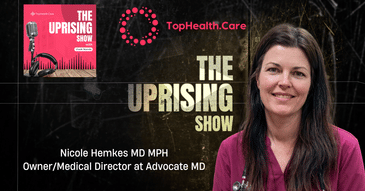
Welcome back to The Uprising Show! In today’s episode, Vivek sits down with Dr. Nicole Hemkes, owner and medical director of Advocate MD, to explore the world of direct primary care and how it’s transforming patient and provider experiences. Tired of the “rushed” and “factory-line” style of traditional fee-for-service medicine, Dr. Hemkes shares her journey from burnout to building her own DPC practice in Madison, Wisconsin. They dive into why time and trust matter in healthcare, what employers often get wrong about quality care, and how giving patients real access to physicians can reduce costs, cut unnecessary referrals, and lead to better outcomes. Don’t miss Dr. Nicole Hemkes’ candid, rapid-fire takes on the chaos of employer healthcare and the most underrated fixes for better care. Tune in for an eye-opening look at what happens when doctors reclaim control over how they practice, and patients reap the benefits.
Timestamps:
00:00 Burnout and finding fulfillment
03:47 Importance of trusted primary care
Direct Primary Care Insights: Dr. Nicole Hemkes on Transforming Healthcare
In a world where the healthcare experience can often feel rushed and impersonal, the direct primary care (DPC) model is offering a refreshing alternative for both patients and providers. In the recent episode featuring Dr. Nicole Hemkes, owner and medical director of Advocate MD, we gained rare insights into how this innovative approach is reshaping the doctor-patient relationship, improving care quality, and making healthcare more accessible.
The Problem with Fee-for-Service Medicine
At the very beginning of the episode, Dr. Nicole Hemkes is asked to describe fee-for-service medicine in one word. Her answer is "Rushed." This single word encapsulates her experience in traditional healthcare settings, where increasing pressure is placed on doctors to see more patients in less time. She explains that, in this environment, doctors are forced into what she calls "factory line medicine," leaving both providers and patients dissatisfied. Many physicians, including Dr. Hemkes, experienced burnout from this system due to the lack of sufficient time with each patient.
Why Direct Primary Care Stands Out
So what inspired Dr. Nicole Hemkes to break away from the traditional system? She was drawn to family medicine by her interest in science and her desire to care for patients of all ages, in various settings. However, after almost ten years in the system, she realized that she could not provide the quality of care she envisioned. This realization was the catalyst for establishing her own direct primary care practice in Madison, Wisconsin.
The DPC model allows her to spend an hour or more with each patient, building stronger relationships and understanding patients' needs deeply. Dr. Hemkes emphasizes that DPC enables her to do the full scope of what she was trained to do as a family physician, which is not possible in the high-volume, referral-heavy traditional setting.
Building a Direct Primary Care Practice from the Ground Up
Starting a new practice is no easy feat, especially without a business background. Dr. Hemkes admits she relied on the guidance of like-minded friends in other states who were already running similar DPC models. She recognized that people in Madison, Wisconsin, were seeking a more personalized and accessible healthcare option. The demand for a model where patients could pay cash, get to know their doctor, and receive timely care led her to take the leap.
Key Differences for Providers and Patients
One of the significant changes for Dr. Hemkes and her team is the smaller patient panel size. This allows for longer, more meaningful appointments and less provider burnout. She notes that it is the first time in her career she has truly enjoyed practicing medicine. Patients benefit as well, not only by having more access to their physician but also through a decrease in unnecessary referrals to specialists.
The Impact of Physician Access
When patients have direct and consistent access to a doctor they trust, healthcare outcomes improve. According to Dr. Hemkes, patients visit urgent care and emergency departments less frequently because they can reach out to their DPC physician after hours. This means fewer unnecessary healthcare visits, lower costs, and better overall care for both employees and employers.
Insights for Employers and the Future of Healthcare
Dr. Hemkes encourages employers to consider who is providing care to their employees. She highlights the importance of time spent with patients and the quality of training and education. In her practice, only physicians provide care, which was an intentional decision to ensure comprehensive service for every patient.
Quick Takeaways from Dr. Hemkes
In a rapid-fire round, Dr. Hemkes describes employer healthcare today as "chaos" and once again calls fee-for-service medicine "rushed." She believes the most underrated fix for better care is paying cash instead of using insurance whenever possible. Her advice for employers choosing providers: value physician access, as it is becoming increasingly rare in today's healthcare climate.
Direct primary care is proving to be a viable solution to some of healthcare's most pressing issues. With advocates like Dr. Nicole Hemkes leading the charge, both patients and providers are finding renewed hope in a system built on time, trust, and true doctor-patient relationships.
The Uprising Show Website: https://theuprisingshow.com/
Vivek Nanda's LinkedIn: https://www.linkedin.com/in/viveknanda1/
Vivek Nanda's Twitter: https://x.com/vickks
TopHealth Media Website: https://tophealth.care/
“Disclaimer: Informational only. Not medical advice. Consult your doctor for guidance.”
[00:00:00] One word for, I guess, fee-for-service medicine. Rushed. And I'd kind of seen this pressure being put on doctors to see more and more patients. So in this direct primary care environment, you can spend, you know, an hour with a patient. It's probably the first time in my career where I really felt, you know, the most enjoyment in being able to practice that way. Nicole Hemkes, Advocate MD, Owner, Medical Director.
[00:00:26] So Dr. Hemkes, why medicine and what pushed you toward practicing in your own terms, which is your direct primary care? What changed for you? How you ended up doing what you're doing? Yeah, so I was always, you know, interested in science and family medicine. I was drawn to because we got to take care of all different ages of patients. You got to, you know, work in a variety of settings, you know, urgent care in the hospital. You got to deliver babies.
[00:00:56] What drew me to direct primary care was because I had worked in the system for about 10 years, and I'd kind of seen this pressure being put on doctors to see more and more patients. So you were spending shorter amounts of time with them, and you kind of just felt rushed. So in this direct primary care environment, you can spend, you know, an hour with a patient. You see many fewer patients. You have a kind of a smaller panel, so you get to know those people a lot better.
[00:01:20] So I thought that that change of pace and just having that closer doctor-patient relationship would be something that I would enjoy doing. And DPC, how you ended up building your direct primary care practice? Yeah, at the time there was no other direct primary care like us in the area of Madison, Wisconsin. So it seemed like there was a need and that maybe people would like this sort of model where they're able to pay cash. Again, they have a, you know, a closer relationship.
[00:01:48] They get in faster with the doctor. So I kind of decided that this would be something that I could do. And in the business side, I didn't really have a business background, but I had some friends that were doing this in other states, similar practices. So I kind of learned from what other doctors were doing and, you know, set up the practice. On your end, how different it is, do you feel from working in the previous model of traditional care to now in direct primary care as a provider? What has changed for you?
[00:02:18] No, I would say a lot of things have changed. I think many doctors, including myself, I was sort of burnt out with, you know, again, just the, you know, what we call like factory line medicine of being pushed to see more and more. And you can't really spend enough time with them. You know, you have to refer them out to other doctors or to do procedures. You don't have time to do the full scope of what you're trained to do as a family physician. So now that I have the time and I can, you know, really connect with my patients,
[00:02:45] I would say that it's probably the first time in my career where I really felt like, you know, the most enjoyment in being able to practice that way. What do employers most misunderstand about what good quality actually requires? Yes, I think it's important to have time. I think doctors and nurses and anyone providing care to a patient need to have enough time with that patient.
[00:03:12] And I think employers also need to know, you know, the quality of the training and education of the person that's providing the care. I think, you know, in our group, we have only physicians and that's been an intentional thing. So I think, again, in the direct primary care environment, we want to take very comprehensive care of those people. So that's why we chose to have physicians only. Is this, as you said, by intentions?
[00:03:36] So I guess what's the impact of this when patients have real access to doctors? What changes for them and also for the plants? Yeah, I think when they have access to a doctor and that's a doctor that they know and they trust, you know, again, they're more likely to come in. They can see us, you know, they could talk to us after hours. So they don't go to the urgent care as much. They don't go to the emergency department as much.
[00:04:01] The doctor can spend enough time with them so that they're not necessarily having to be referred out to a specialist. So that helps in terms of the downstream referrals with employers and just gets kind of cross containment. And if they did need something beyond our clinic, you know, we help kind of navigate to where they can go for those things. But I think, again, most patients, if they have a doctor that they trust, that they know that they can see when they're sick, that's going to allow us to do much more in a primary care setting.
[00:04:28] I'm not going to ask you rapid fire questions. Whatever your first thought is, just tell us that answer. Where is employer health care today? Is it chaos or control? Chaos. Okay. One word for, I guess, fee for service medicine. Rushed. Rushed Okay.
[00:04:55] Most underrated fix for better care? I think paying cash for things, not using your insurance and paying cash as much as you can. Okay. And one thing you would change about how employers pick providers, I guess. I think, you know, understanding and the importance of who your employees are seeing, you know, making sure that they have access to a physician. And I think it's becoming harder and harder in the system to see a doctor. I think it's becoming harder. I think it's becoming harder. I think it's becoming harder. I think it's becoming harder. I think it's becoming harder.